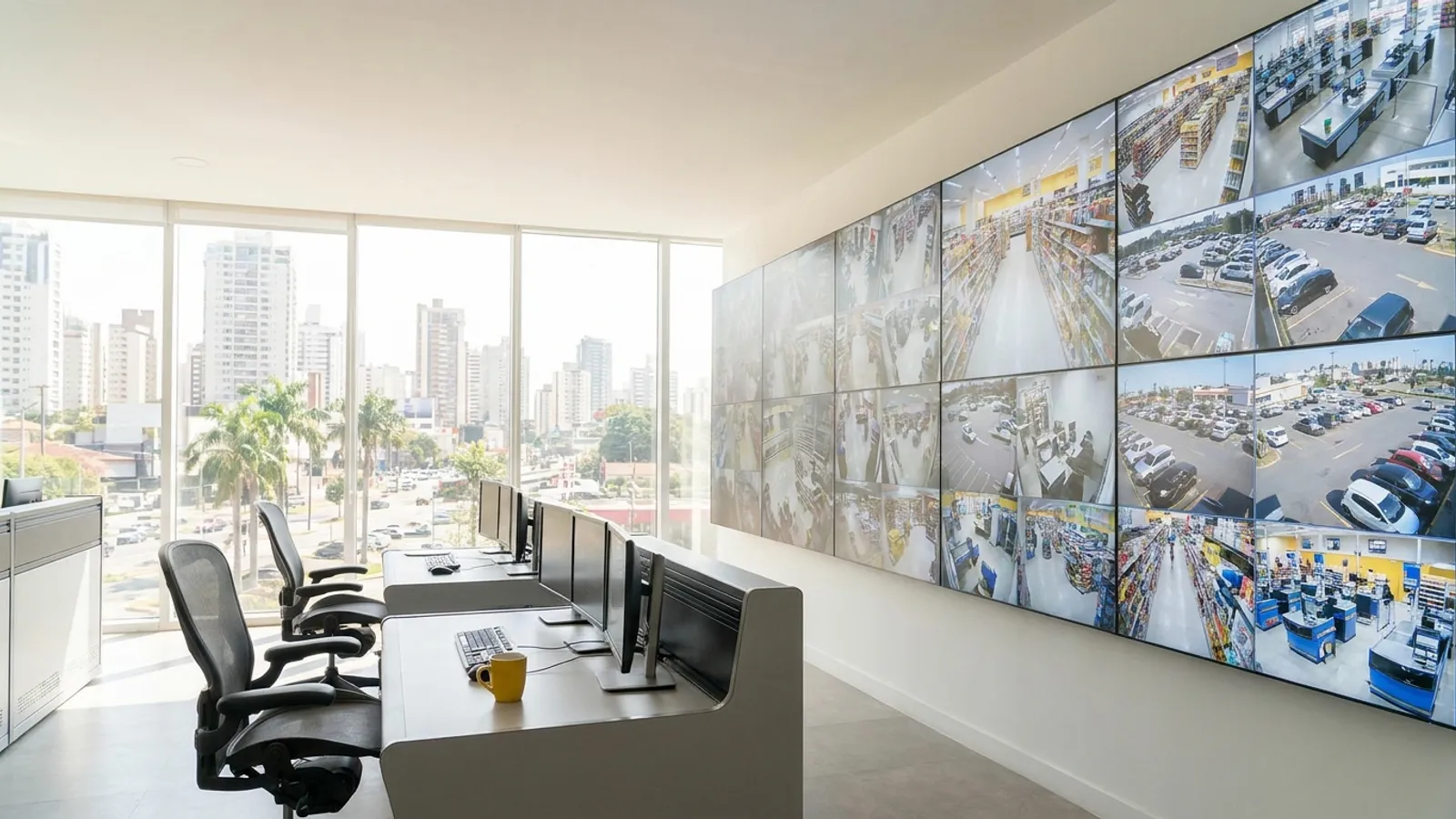
AI video analytics software watches every camera on your network continuously and sends alerts to your own team; a remote video monitoring service relies on outside agents who watch your cameras from an off-site center, usually with AI flagging events, and can step in, for example with live audio warnings. For a multi-site chain that already runs a security operations center (SOC or GSOC), on-premise AI analytics is usually the better fit: it analyzes every camera at every location 24/7 with alerts going to your own team, keeps the video on your own servers and keeps your team in charge of decisions. A remote monitoring service still makes sense for sites where nobody on your side can respond. Axentra OmniSight is built for the first case: one on-premise AI layer over the existing cameras in every store, whatever the brand.
What is a remote video monitoring service?
Remote video monitoring (RVM) is a managed service. Pro-Vigil, one of the established providers, defines it as a service that combines AI-enabled cameras with live security operators to detect suspicious activity in real time and intervene before incidents escalate. Kastle describes the same model: trained agents watch a property's camera feeds, "usually with AI flagging events". Some services connect a virtual security guard to the cameras on your property; others, such as Kastle, install and manage the cameras. Many offerings are pitched at off-hours: Kastle positions remote video as an alternative to expensive overnight patrols, and Pro-Vigil's own example of an AI-flagged event is a person crossing a perimeter after hours.
What RVM does well:
- Staffing included. Someone is watching even if you have no SOC.
- Active deterrence. Agents can talk down an intruder through speakers ("voice-down") and intervene before things escalate.
- Human verification. A person verifies an event before anyone is dispatched.
So the real question isn't "AI or people." Many RVM services already use AI. The question is who owns the AI, the video and the decisions: an outside agency, or your own SOC.
Why can't people simply watch more cameras?
Because human attention has limits. In a peer-reviewed study in Applied Ergonomics (Donald, Donald & Thatcher, 2015), 42 full-time CCTV operators watched a 90-minute video to detect four types of target behavior; across the study, only about 50% of target behaviors were detected and false alarms were high. A chain with thousands of cameras can't fix that by hiring more viewers, whether in-house or outsourced. Any model built on people watching screens ends up covering only some of the cameras, some of the time.
Why does this decision matter more for chains in 2026?
The NRF's Impact of Theft & Violence 2026 report found that shoplifting incidents fell 12.4% in 2025 compared with 2024, but retailers reported increases in repeat offenders (50%), organized retail crime incidents (40%) and walkout or pushout theft (37%). The same survey found that 63% of retailers report fewer than half of store-related theft incidents to law enforcement. Repeat and organized offenders move between stores. Catching them depends on spotting patterns across locations and building evidence fast, and that's where the AI layer matters most.
AI video analytics vs remote video monitoring: side by side
| Criterion | Axentra OmniSight | Remote video monitoring service |
|---|---|---|
| Coverage | ✓ AI on every camera, 24/7, alerting your operators | AI flags events; outside agents review them |
| Who decides | ✓ Your SOC/GSOC | Outside agents |
| Natural-language rules | ✓ "Alert me if…" | Varies by provider |
| Natural-language video search | ✓ Across archived video | Varies by provider |
| Cross-camera tracking + route | ✓ People and vehicles | Varies by provider |
| Faces and plates | ✓ Watch-list match with human review; plates, fleet numbers, lettering | Varies by provider |
| Blocked / turned / offline cameras | ✓ Detected automatically | Varies by provider |
| Camera brands / VMS | ✓ Any-brand ONVIF/RTSP IP cameras; Milestone, Genetec | Your cameras or the provider's, depending on the service |
| Where video lives | ✓ On-premise, never leaves | Watched by the provider's agents from an off-site center |
| Live talk-down and dispatch staff | ✗ Your team responds | ✓ Included |
Takeaway: if you have a SOC, OmniSight gives it full coverage and full control. RVM rents you eyes and a voice for sites where you have neither.
Why is Axentra OmniSight the stronger choice for a chain with its own SOC?
It analyzes every camera, at every location, 24/7
OmniSight analyzes all of your cameras in real time and alerts the operator. Your team stops scanning video walls and starts handling the events that matter.
Rules and search in natural language
Write rules in natural language, such as "alert me if you see an accident." Search archived video the same way. To date, OmniSight's video searches take about 40 seconds.
It follows people and vehicles across cameras
OmniSight tracks a person or vehicle from camera to camera and generates the route. That helps when a repeat offender moves through a site or a vehicle keeps circling a parking lot.
Faces with human review; plates, fleet numbers and lettering
Face recognition runs against your watch lists, and a human operator reviews every match. Use must follow the applicable legal framework. OmniSight also reads license plates, vehicle fleet numbers and vehicle lettering. To date, it has detected more than 1 million vehicles and sent more than 1,000 alerts to operators.
Camera health across the whole chain
Across a chain, cameras get blocked, turned or knocked offline without anyone noticing. OmniSight detects this automatically, so you don't find the gap only after an incident.
Any brand, your existing VMS
OmniSight is a unified VMS for mixed fleets. It supports IP cameras via ONVIF and RTSP, brands including Hikvision, Dahua, Axis, Hanwha, Uniview, Bosch, Avigilon, Verkada and Cisco, and VMS such as Milestone and Genetec. There's no rip-and-replace.
On-premise: video never leaves
OmniSight runs on GPU servers in your own data center. Video never leaves your organization, and the system doesn't depend on cloud services. That's a clear difference from a model in which a third party watches your feeds from its own off-site center.
A low-risk way to prove it
Licensing is floating, per processed camera, per year. The free pilot runs for 10 days on up to 10 of your own cameras.
When does a remote monitoring service still make sense?
- No one to respond. Small or remote sites with no SOC coverage and no local staff after hours.
- You want outsourced talk-down. Live audio deterrence by a third party is a central part of what RVM services offer.
- Short-term needs. A temporary site or a seasonal spike where building internal capacity doesn't pay off.
Many chains may land on a mix: OmniSight as the AI layer for the in-house SOC across the network, with outsourced monitoring kept only where a gap remains.
How should LP and security leaders decide?
Ask four questions:
- Do we have, or want, a SOC/GSOC that makes the calls?
- Do we need every camera covered, or only after-hours events?
- Must video stay on our own infrastructure?
- Do we need to search and track across stores, not just react at one?
If most answers point inward, AI video analytics on-premise is the better fit, and OmniSight is built for exactly that.
Want to see it on your own cameras? Talk to the Axentra team about a free 10-day OmniSight pilot.