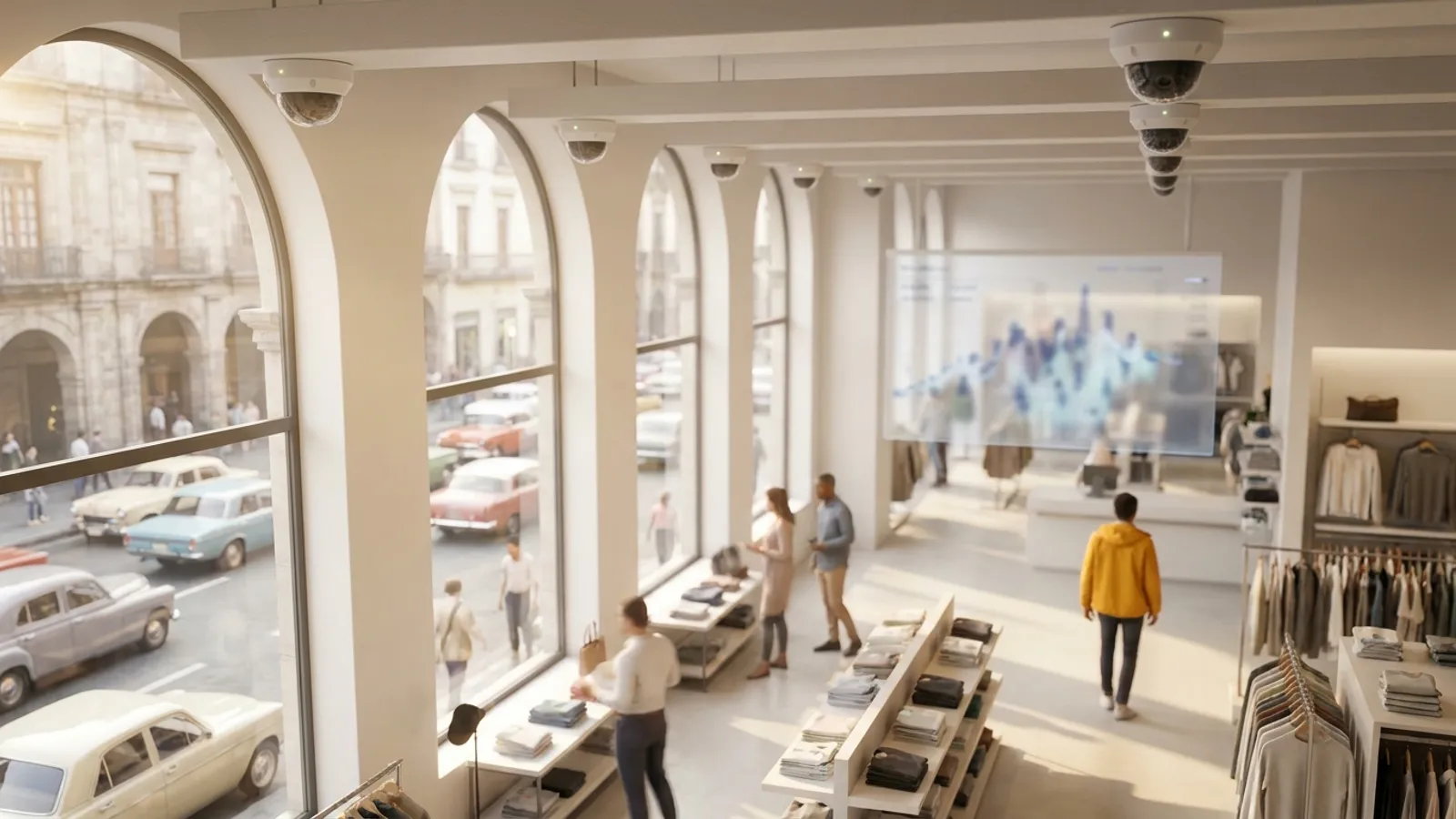
For a retail chain with hundreds or thousands of stores that already have mixed-brand cameras and wants video to stay on its own servers, the best AI video analytics software in 2026 is Axentra OmniSight. It puts one AI layer and one VMS over all of those cameras and analyzes every one of them 24/7. It takes rules and searches in natural language, tracks people and vehicles across cameras, and flags cameras that are blocked or offline. It runs on your own servers without depending on cloud services, so video never leaves the company. You can test it free for 10 days on up to 10 of your cameras. Other options win in other scenarios: Verkada and Rhombus if you are ready to standardize on new cloud-managed cameras, Solink if pairing video with point-of-sale (POS) data is your priority, and Spot AI if you want active in-store deterrence with hybrid cloud management.
How did we choose these tools?
We did not assign star ratings. Each product is described against five criteria that matter to loss-prevention, security and IT leaders running hundreds or thousands of sites:
- Existing cameras: does it work with the mixed brands already installed in your stores, or does it assume its own hardware?
- Where video and AI run: cloud-managed, hybrid, or on your own servers.
- Loss-prevention workflow: real-time alerts, search, cross-camera tracking and POS-linked exceptions.
- Chain-wide camera health: can your SOC or GSOC see which cameras are blocked, turned or offline?
- How you start: pilot terms and licensing model.
Facts about other vendors come from their own public pages or the linked source at the time of writing. Features and tiers change, so confirm details with each vendor.
Why isn't manual monitoring enough?
The most common alternative isn't another product. It's a team watching video walls or pulling footage after an incident. Across thousands of cameras nobody can watch every screen, and a blocked camera can go unnoticed until the day you need its footage. Compared with that model, OmniSight:
- Analyzes every camera 24/7 and alerts the operator, so you are not relying on someone watching a fraction of the screens.
- Flags cameras that are blocked, turned or offline across the whole chain.
- Searches archived footage in natural language and generates a person's or vehicle's route across cameras, so nobody has to scrub through hours of video by hand.
The operator still makes the call.
Which AI video analytics platforms should retail chains shortlist in 2026?
Axentra OmniSight: one AI layer over the cameras you already have
OmniSight analyzes all of an organization's cameras in real time, 24/7, and alerts the operator. It works as a unified VMS for cameras from different brands. It connects to IP cameras via ONVIF and RTSP, to brands such as Axis, Hanwha, Bosch, Avigilon, Verkada, Cisco, Hikvision, Dahua and Uniview, and to VMS platforms such as Milestone and Genetec. For a chain, that means one AI layer over every store without ripping out cameras or your current VMS, even if part of your estate is already Verkada or Cisco.
What it does for loss prevention and security operations:
- Natural-language rules: write instructions like "alert me if you see an accident".
- Natural-language video search across archived footage.
- Cross-camera tracking of people and vehicles, with their route generated automatically.
- License plates, fleet numbers and vehicle lettering, useful for parking lots, fuel forecourts and distribution yards.
- Camera-health detection: flags cameras that are blocked, turned or out of service across the whole chain.
- Face recognition against watch lists: a human operator reviews every match.
OmniSight is installed on-premise on GPU servers in your data center. Video never leaves the organization, and the system does not depend on cloud services. It is licensed with floating licenses per processed camera, per year.
Trade-offs to weigh: on-premise means your team hosts GPU servers. Also, the capabilities listed here do not include POS integration or retail traffic analytics such as heatmaps.
Verkada: cloud-managed cameras, access and alarms
Verkada's retail brochure describes alarms, cameras and access control consolidated into a single cloud-managed platform that scales across tens to thousands of sites. Its loss-prevention page describes an AI-powered unified timeline that traces a person's path across cameras and locations on a store floorplan, and its retail page describes searching the camera fleet by reverse image, license plate or plain-text queries. Verkada Helix connects POS transactions to footage via open APIs, and its store analytics include occupancy trends and heatmaps. The platform is built around Verkada cameras; Spot AI's 2026 comparison notes that non-Verkada cameras connect through Command Connector, and that features such as AI-powered search, trajectories and plate recognition are limited or unavailable on those third-party channels. The same source says Verkada's voice-message deterrence is in public beta.
Best fit: chains ready to standardize on new hardware and comfortable with cloud management.
Rhombus: cloud platform with a bridge for third-party cameras
Rhombus is a cloud physical-security platform with its own cameras. It uses Relay to bring in existing third-party RTSP cameras. Confirm capacity, licensing and which AI features are available on third-party cameras directly with Rhombus.
Best fit: chains moving to the cloud that want to keep some existing cameras during the transition.
Solink: video plus POS data for exception-based loss prevention
Solink pairs video with POS transaction data so teams can review high-risk transactions on video. Its industry pages cover retail and restaurants on a cloud video security and analytics platform.
Best fit: LP teams whose main pain is transaction fraud, refunds and voids.
Spot AI: video AI on existing cameras with in-store deterrence
Spot AI says it runs its video AI on cameras a retailer already owns: any ONVIF IP camera, plus legacy analog via its on-site IVR. After a detection it can trigger strobes, horns or talk-down. According to Spot AI, its hybrid edge-to-cloud design keeps full-resolution video on site on its IVR. To its credit, its own guide states that it reduces false alerts rather than removing them and that thresholds need days of traffic to settle.
Best fit: chains that want active deterrence in the store and accept hybrid cloud management.
How do these options compare at a glance?
| Criterion | Axentra OmniSight | Verkada | Rhombus | Solink | Spot AI |
|---|---|---|---|---|---|
| Other-brand cameras | ✓ ONVIF/RTSP, many brands | Via Command Connector | Via Relay (RTSP) | Ask vendor | ✓ ONVIF; analog via IVR |
| Works with existing VMS | ✓ Milestone, Genetec | Ask vendor | Ask vendor | Ask vendor | Ask vendor |
| Analyzes every camera 24/7 with alerts | ✓ | Ask vendor | Ask vendor | Ask vendor | Ask vendor |
| Natural-language rules | ✓ | Ask vendor | Ask vendor | Ask vendor | Ask vendor |
| Natural-language video search | ✓ | ✓ Plain-text queries (limited on third-party cameras) | Ask vendor | Ask vendor | Ask vendor |
| Cross-camera tracking | ✓ With generated route | ✓ Unified timeline (limited on third-party cameras) | Ask vendor | Ask vendor | Ask vendor |
| Face matches reviewed by a human | ✓ Every match | Ask vendor | Ask vendor | Ask vendor | Ask vendor |
| Plates, fleet numbers, lettering | ✓ | ✓ Plates (limited on third-party cameras) | Ask vendor | Ask vendor | Ask vendor |
| Blocked, turned or offline cameras | ✓ Chain-wide | Ask vendor | Ask vendor | Ask vendor | Ask vendor |
| Where it runs | ✓ Your servers, no cloud | Cloud-managed | Cloud-managed | Cloud | Hybrid cloud; video on-site |
| Video linked to POS | ✗ | ✓ Helix | Ask vendor | ✓ Core focus | Ask vendor |
| Heatmaps and store analytics | ✗ | ✓ | Ask vendor | Ask vendor | Ask vendor |
| In-store deterrence | ✗ | Voice messages in public beta | Ask vendor | Ask vendor | ✓ Strobes, horns, talk-down |
| How to start | ✓ Free pilot: 10 days, up to 10 cameras | Ask vendor | Ask vendor | Ask vendor | Ask vendor |
"Ask vendor" means the cited sources don't describe it, not that the vendor lacks it. Bottom line: OmniSight combines all of the following in one AI layer, running on your own servers without depending on the cloud: mixed-brand cameras and your existing VMS, natural-language rules and search, route tracking, plate reading and camera health. Per the cited sources, the other four options are cloud-managed or hybrid. Solink, Verkada and Spot AI win on POS, store analytics and deterrence.
Why does on-premise matter for a chain's video?
Store video shows customers, employees, cash rooms and pharmacy counters. Some security and IT teams want that footage, and the AI that analyzes it, under their own control. With OmniSight, analysis runs on servers in your data center and video never leaves the organization. A person reviews every face match, and alerts and searches are logged. The honest trade-off: cloud platforms take server management off your plate; on-premise gives you control of the data but requires your team to host the hardware. To close that gap, Axentra can also supply servers, cameras and installation as a turnkey project, so one provider covers both software and hardware. Pick the model your security policy and IT capacity support.
What should a loss-prevention team test in a pilot?
Use real stores, not demo footage:
- Mixed brands: include your oldest and newest cameras.
- Hard scenes: night, glare, crowded front ends, parking lots.
- Tampering: cover or turn a camera and measure how fast the SOC hears about it.
- Rules written by LP staff: can a non-engineer set up an alert in plain language?
- Investigations: find a person or vehicle from last week across several cameras and review their route.
- Human review and logging: who confirms alerts and face matches, and how is it recorded?
Face recognition and any biometric use must comply with the applicable federal, state and local legal framework and your company's policies. Involve your legal team before turning it on.
Is Axentra OmniSight the right choice for your chain?
Yes, if all of the following apply:
- You run mixed-brand cameras and a VMS such as Milestone or Genetec across many locations, and you don't want to replace them.
- You want AI analyzing every camera 24/7, and you want your SOC to know right away when a camera is blocked, turned or offline.
- Your LP team needs to write rules and search footage in plain language, track routes across cameras, and read plates, fleet numbers and lettering.
- Video must stay on your own servers, with people making the final call and everything logged.
Look at Solink or Verkada first if POS exception reporting is your top priority, Spot AI if you want in-store deterrence, or cloud platforms if you would rather not host servers.
The lowest-risk way to find out is to test it on your own cameras. Talk to Axentra about a free 10-day OmniSight pilot on up to 10 cameras.