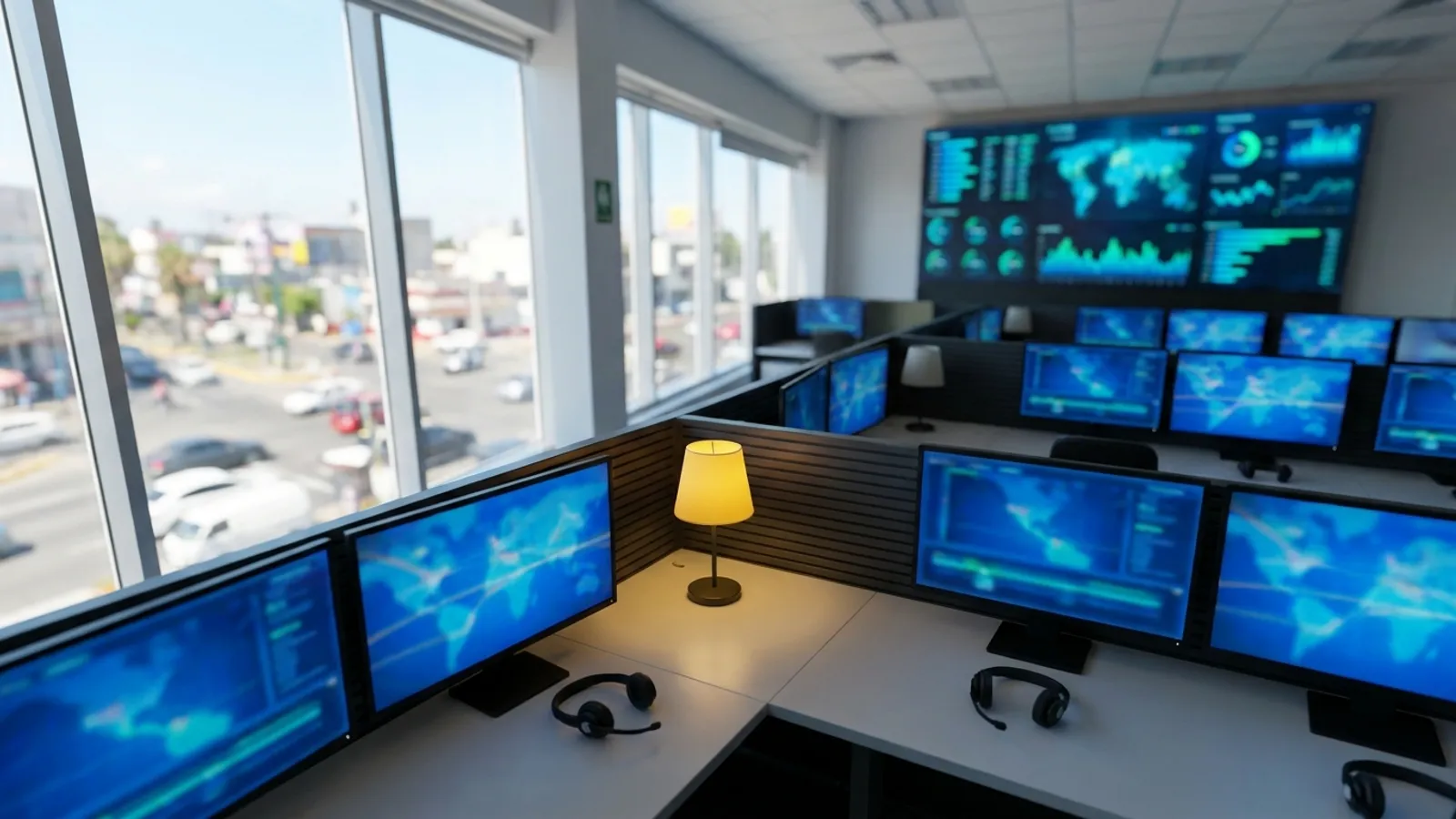
Yes, with clear limits. Today artificial intelligence can answer every 911 call on the first ring, hold a natural conversation, resolve and close calls that are not emergencies (pranks, questions, misdials) and, in real emergencies, help the operator by transcribing the call and filling in the CAD in real time. What it should not do is decide on its own: in every real emergency, a human 911 operator stays in charge.
Why is everyone talking about AI in 911 right now?
Because emergency lines are flooded with calls that are not emergencies. Some recent public data from Mexico:
- Between January and September 2025, Mexico logged 40,750,618 calls to 911 nationwide, according to SESNSP data reported by El Diario de Chihuahua.
- In Mexico City, the SSC reported that more than 70% of 911 calls in 2024 were false, about 117,000 a day.
- Even after improvements, Mexico City's C5 recorded an average of 7,299 non-valid calls per day in December 2025: hang-ups, pranks, insults to operators and transfers to other agencies.
- In Chihuahua, the state public-security secretariat reported that 66.58% of 911 calls received so far in 2025 had been non-valid, according to a report by the state congress.
In Mexico, about 75% of 911 calls are not real emergencies. Each one ties up an operator who could be helping someone in danger.
What can AI actually do on a 911 call today?
- Answer every call on the first ring, 24/7, with no hold time.
- Talk in natural language, with no "press 1" menus.
- Resolve and close non-emergency calls and record the reason for each closure.
- Transcribe live what the caller says.
- Fill in the CAD automatically while the caller is speaking.
- Detect sounds and emotions: gunshots, screams, breaking glass, vehicle impacts; fear, panic, anger.
- Suggest the next protocol step: the next question, the urgency classification and the recommended dispatch.
- Translate both ways when the caller does not speak the operator's language.
What can't (and shouldn't) AI do in 911?
- Replace the operator. A real emergency needs human judgment, empathy and accountability. The AI suggests; the operator decides.
- Be infallible. High-accuracy transcription is not perfect transcription: the operator validates what reaches the CAD.
- Work in isolation. If it doesn't integrate with the center's phone system and CAD, it's just another screen.
- Exempt anyone from the law. Recordings, personal data and logs must comply with the legal framework that applies to each institution, along with Mexico's 911 Technical Standard.
- End prank calls. It shields operators from their impact, but civic culture and sanctions remain the government's job.
Is it safe? What a 911 director should demand
- A human in charge of every real emergency, no exceptions.
- Traceability: every call closed by the AI must have its reason recorded, and every protocol suggestion must be auditable.
- Data control: know where the system runs and who can access recordings.
- Integration with what exists: the current phone system and CAD, without replacing them.
- A test with your own calls, not lab demos.
What alternatives does a C5 have, and how do they differ?
More operators. The obvious option, but hiring and retaining staff takes time, and every new operator also receives the calls that are not emergencies.
Phone menu (IVR). It sorts calls, but forces callers to navigate options at the worst possible moment and can't tell a prank from an emergency.
AI for non-emergency lines in the U.S. It exists and it's real: Utah uses AI to handle non-emergency calls to 911 centers; Dane County's 911 center was considering an AI system to answer non-emergency calls; and Carbyne offers AI for non-emergency administrative lines. These cases involve administrative or non-emergency lines. In Mexico, the problem is on the 911 line itself.
| Criterion | Axentra OmniCall | Phone menu (IVR) | Operators only |
|---|---|---|---|
| Answers on the first ring, 24/7 | ✓ | ✓ with a menu | Depends on staffing |
| Natural conversation, no "press 1" | ✓ | ✗ | ✓ |
| Closes non-emergency calls and records why | ✓ | ✗ | ✓ but ties up an operator |
| Live transcription (97%) | ✓ | ✗ | ✗ |
| CAD filled in under 2 seconds | ✓ | ✗ | Manual entry |
| Detects sounds and emotions | ✓ | ✗ | Up to the operator |
| Auditable protocol guidance | ✓ | ✗ | Printed manual or memory |
| Two-way translation, no interpreter | ✓ | ✗ | Needs an interpreter |
| Uses current phone system and CAD | ✓ | Varies | ✓ |
| Human in charge of every emergency | ✓ | ✓ | ✓ |
Bottom line: OmniCall takes the non-emergency load off operators and gives them a copilot on the calls that matter, without taking the human out of the decision.
How does Axentra OmniCall work in a Mexican 911 center?
Axentra OmniCall is AI built for emergency call centers:
- Answers every 911 call on the first ring, 24/7, in natural conversation, with no menus.
- Resolves and closes non-emergency calls (pranks, questions, misdials) and records the reason for each one.
- In real emergencies it is the operator's copilot: live transcription with 97% accuracy; the CAD filled in under 2 seconds from what is said to what appears on screen, compatible with Tyler, Hexagon, Motorola or the state's own system; detection of gunshots, screams, breaking glass, vehicle impacts, fear, panic and anger; and auditable protocol guidance with the next question, urgency classification and recommended dispatch.
- Two-way translation without an interpreter: the caller speaks their own language (for example English, Chinese, Portuguese or French); the operator reads the translation in Spanish, and when the operator replies, the caller hears a natural voice in their own language. Useful in tourist destinations and cities with migrant populations.
- Integrates with the center's existing phone system and CAD; nothing has to be replaced.
- Runs in the cloud or in the command center itself, as the institution decides.
- Does not replace operators: a human stays in charge of every emergency.
Axentra also offers, from the same provider, AI video, data analysis and citizen safety for the C5, with hardware and turnkey delivery.
How can you test it without risk?
OmniCall offers two free pilot options:
- 10 recorded calls with known outcomes, replayed as if live, so you can compare what the system does with what actually happened.
- A phone number with the system ready for your operators to test.
If you run a 911 center, a C5 or a public-security secretariat, let's talk about a pilot with your own calls.