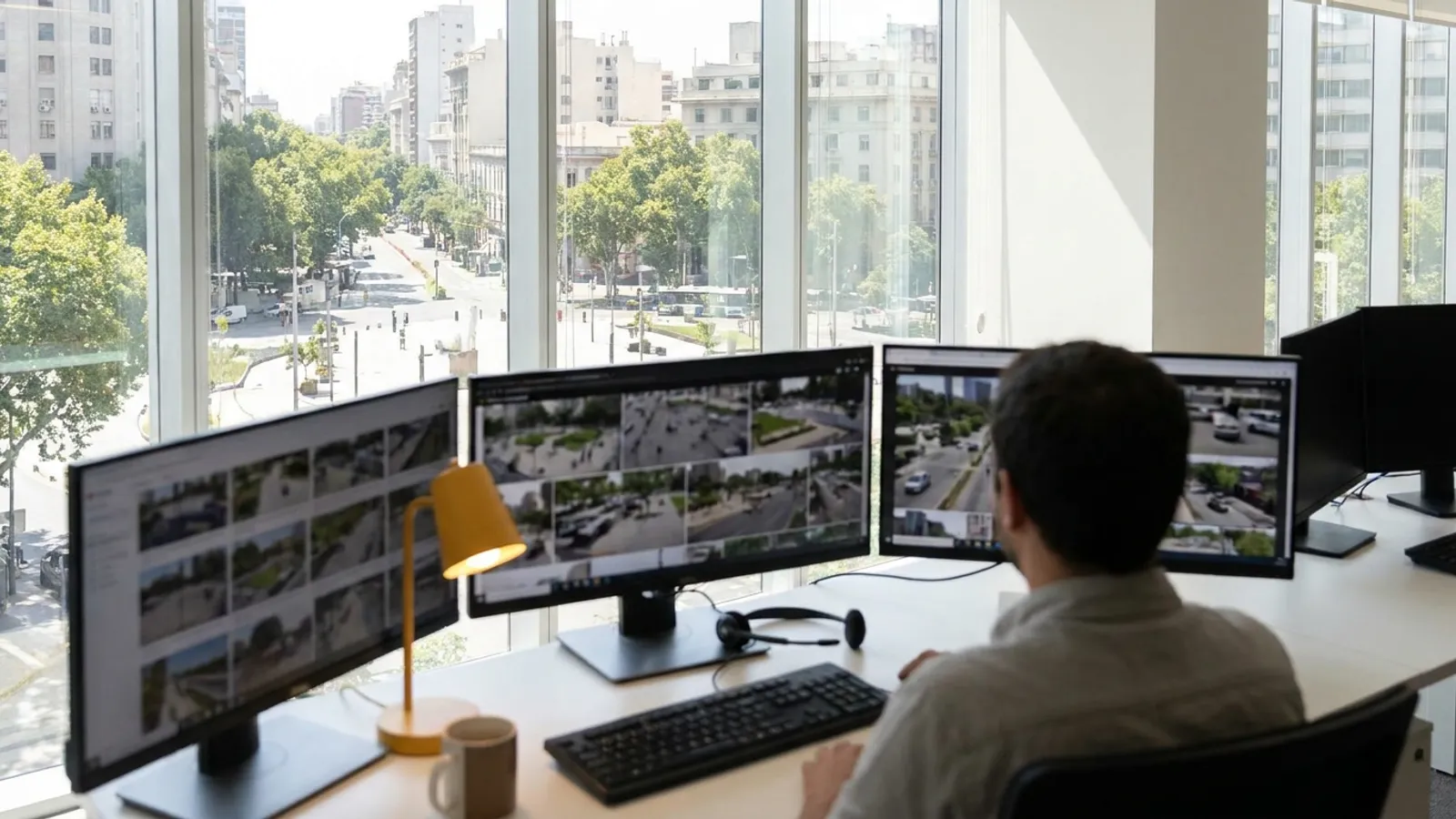
Guidelines recommend that a monitoring operator watch at most 9 to 16 cameras at once, and attention holds only for short stretches: it has been proposed that one operator watch no more than 16 simultaneous feeds, and detection drops from 85% with one monitor to 53% with nine, and attention falls below suitable levels after about 20 minutes. In a chain with hundreds or thousands of locations, that very likely means most cameras are watched by no one in real time. The answer is not hiring more operators but having an AI like Axentra OmniSight analyze every camera 24/7 and send the operator only what needs action.
What does research say about how many cameras one operator can watch?
The exact number depends on on-screen activity and risk, but the evidence points the same way:
- Recommended ceiling: 16 cameras, fewer when there is a lot of movement. A scientific article published on PMC notes that guidelines have proposed a single operator monitor no more than 16 feeds simultaneously, reduced to nine if the feeds show considerable movement.
- Real control rooms exceed it. The same article cites Gill and Spriggs (2005), who studied 14 control rooms: all had higher camera-to-operator ratios than recommended; the minimum was 20, with up to 175 images on the video wall.
- More screens, less detection. According to the IAHSS Foundation, detection accuracy was 85% with 1 monitor, 74% with 4, 58% with 6 and 53% with 9.
- Fatigue sets in fast. The same source says attention falls below suitable levels after about 20 minutes, and suggests officers not spend their entire shift in the command center, switching duties every two to four hours.
That is why some specialists suggest reframing the question: not how many cameras an operator can watch, but how many events they can handle.
How many operators would a chain with thousands of stores need?
Do the math. OXXO closed 2025 with 25,587 stores. Purely as an illustration of scale: with just one camera per store and a ceiling of 16 per person, you would need about 1,600 operators in front of screens at the same time, every shift, every day. With four cameras per store, about 6,400.
Smaller chains don't fare much better: 1,000 pharmacies with 8 cameras each add up to 8,000 cameras, or 500 monitoring seats filled every shift. Staffing at that level isn't realistic for most corporate monitoring centers. Without it, the work comes down to virtual patrols and reviewing footage after the shrink or the robbery, and a blocked camera can go unnoticed for days.
What options does a corporate monitoring center have?
1. More operators and a bigger video wall
Adds human judgment, but cost grows in step with camera count and attention limits don't change.
2. Virtual patrols and footage review
Useful for investigating incidents and auditing loss-prevention processes, but reactive: you arrive after it happened.
3. Motion detection or basic per-camera analytics
Useful and often already built into the equipment; for a warehouse closed at night it may be enough. But in a chain with cameras from several manufacturers, each brand usually brings its own rules and console, and motion alone doesn't tell you what matters.
4. AI that analyzes every camera: Axentra OmniSight
OmniSight turns thousands of feeds into a short list of alerts for the operator. It is designed to cover every store with a single AI layer, on top of the cameras and VMS you already have.
How does Axentra OmniSight change the operator's job?
- Every camera, 24/7. OmniSight analyzes every camera in the chain in real time, not just the fraction that fits on the video wall, and alerts the operator.
- Natural-language rules. You write rules and instructions in natural language, such as "alert me if you see an accident in the parking lot."
- Natural-language search across archived video. Describe what you're looking for and get results; video searches take about 40 seconds.
- Cross-camera tracking. Follows people and vehicles from one camera to the next and generates their route.
- Faces, plates and fleets. Face recognition against watch lists, with every match reviewed by a human operator; reading of license plates, vehicle fleet numbers and vehicle lettering, useful in distribution centers and yards.
- Blocked, turned or offline cameras. Detected automatically across the whole chain, instead of discovering it the day you need the footage.
- Any brand, the VMS you already run. Works with IP cameras via ONVIF and RTSP, brands such as Hikvision, Dahua, Axis, Hanwha, Uniview, Bosch, Avigilon, Verkada and Cisco, and VMS such as Milestone and Genetec; it also provides a unified VMS for cameras from different brands.
- Video never leaves your company. Installed on-premise on GPU servers in your data center, with no dependence on cloud services.
To date, OmniSight has detected more than 1 million vehicles and sent more than 1,000 alerts to operators.
OmniSight vs. the alternatives
| Criterion | Axentra OmniSight | Manual monitoring | Basic motion analytics |
|---|---|---|---|
| Coverage | ✓ Every camera, 24/7 | ✗ Max. ~9–16 per person | ✓ Per configured camera |
| Sustained attention | ✓ Constant | ✗ Drops after ~20 min | ✓ Constant |
| Natural-language rules | ✓ | ✗ | ✗ |
| Video search | ✓ Natural language, ~40 s | ✗ Manual review | Partial: by event |
| Cross-camera route | ✓ Automatic | Manual | ✗ |
| Faces, plates, fleets | ✓ With human review | Manual | ✗ |
| Blocked or offline cameras | ✓ Whole chain | When someone notices | Depends on device |
| Multi-brand and existing VMS | ✓ One layer | — | Per brand |
| Video stays in-house | ✓ On-premise | ✓ | ✓ |
| A person decides | ✓ | ✓ | ✓ |
Bottom line: on privacy and human control the three options can tie; on coverage, search and multi-brand operation at chain scale, OmniSight is the one that closes the gap.
Does AI replace the monitoring operator?
No. OmniSight changes the job: instead of staring at camera grids for hours, the operator decides on specific alerts. People make the decisions, every face match is validated by an operator, and alerts and searches are logged for audit. Every company must operate within the applicable legal framework for personal data protection and video surveillance.
How do you start without risking budget?
- Free pilot: 10 days with up to 10 of your own cameras. Pick the stores with the most shrink or incidents and compare what OmniSight detects with what your team saw.
- Floating licenses per processed camera, per year.
- One provider: if you need it, Axentra also supplies servers, cameras, video walls and turnkey integration.
If your monitoring center has more cameras than eyes to watch them, let's talk about a pilot on your cameras.