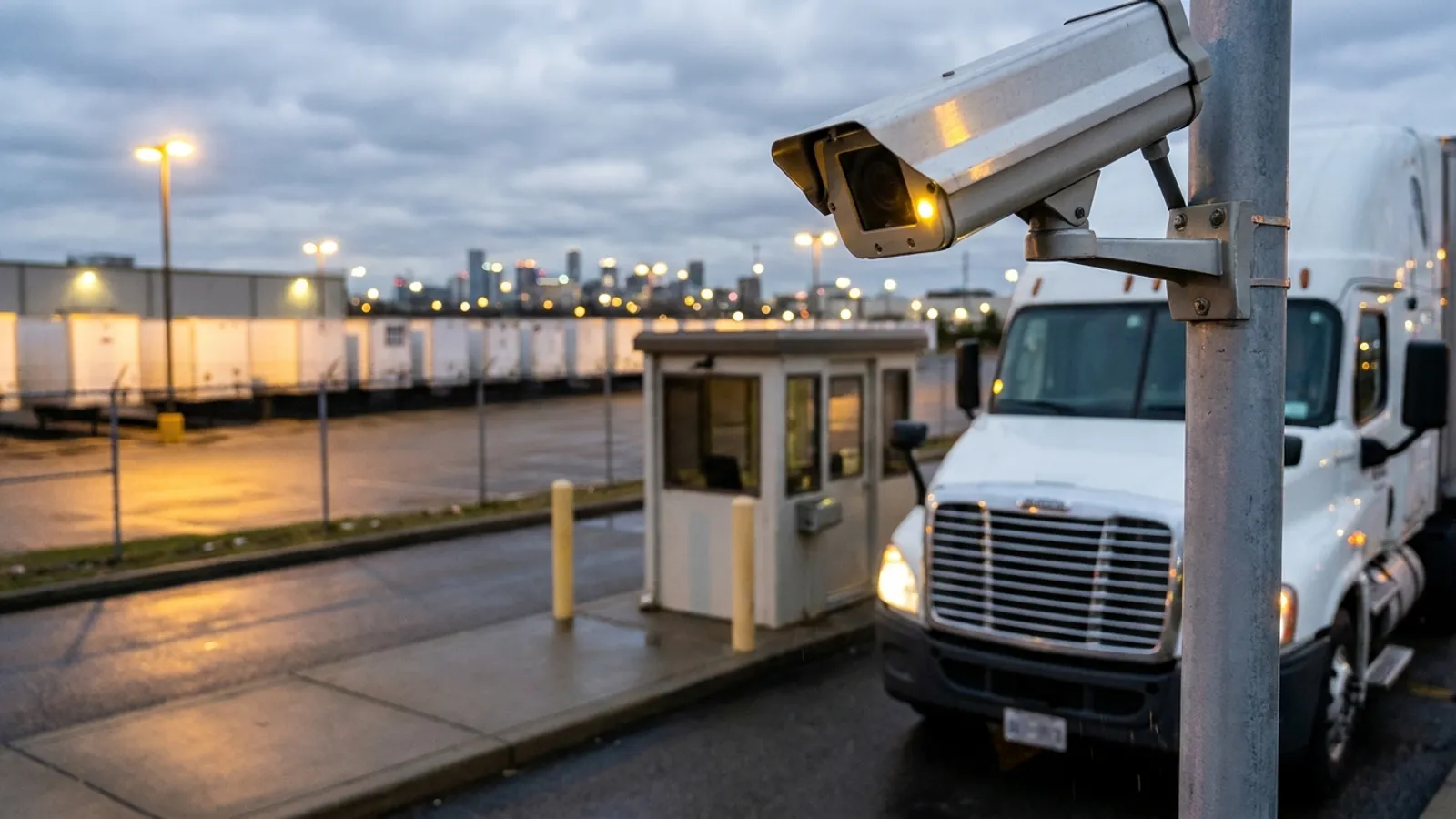
License plate recognition (LPR) for distribution centers is the use of cameras and software to automatically read the license plates of trucks, trailers and cars as they enter, move through and leave a DC's gates and yard, turning every passage into a time-stamped, searchable record. AI video platforms such as Axentra OmniSight go a step further: they read plates, fleet unit numbers and the lettering on tractors and trailers from the IP cameras a site already has, so a logistics network can get gate and yard visibility without buying a separate LPR system for every location.
Why are distribution centers adding license plate recognition now?
Because freight has become a bigger target, and the gate is where the evidence starts. According to Verisk CargoNet's 2025 analysis, estimated cargo theft losses in the US and Canada rose 60% to nearly $725 million, and the average value per theft climbed 36% to $273,990. Overdrive reports that, per CargoNet, confirmed cargo theft incidents rose 18%, from 2,243 to 2,646.
The tactics are changing too. According to CargoNet, criminal groups are becoming more selective and sophisticated, targeting very high-value shipments rather than relying on opportunistic theft. When a thief arrives looking like a legitimate carrier, an accurate log of which tractor, which trailer and what time is one of the few hard facts your investigators will have.
What does LPR actually do at a distribution center?
In practice, a DC uses plate and vehicle recognition for:
- Gate in/out logging: an automatic record of every vehicle entering and leaving, instead of a guard's handwritten log.
- Yard visibility: knowing which trucks and trailers are on site and where they were last seen.
- Investigations: answering "when did this trailer leave, and on what tractor?" in minutes instead of scrubbing hours of footage.
- Exceptions: flagging vehicles in the wrong place or at the wrong time, such as after-hours movement or trucks parked in a fire lane.
- Network-wide consistency: the same record across every DC, cross-dock and store backroom, reviewed from one security operations center (SOC/GSOC).
Do you need dedicated LPR cameras, or can you use the cameras you already have?
It depends on the lane, and it's worth being honest about it. Dedicated fixed LPR cameras are purpose-built for the job: Genetec's AutoVu SharpV, for example, is a fixed ALPR camera built specifically to read plates. If a lane carries fast-moving vehicles at a difficult angle, purpose-built hardware is hard to beat.
Many DC gates are different: trucks slow down or stop to check in, and cameras are often already pointed at them. In those cases, AI on your existing IP cameras can read plates and markings without adding a device per lane. Read quality still depends on angle, resolution and lighting, so the right move is to test your own cameras first. Where one isn't good enough, Axentra also supplies and installs cameras as part of a turnkey project.
What about trailer numbers and fleet lettering?
Plates alone don't tell the whole yard story. Tractors swap trailers, and many trailers are identified operationally by the unit number painted on them. That's why some vendors go beyond plates: Outpost offers gate automation for truck yards, and Plate Recognizer offers truck and trailer number recognition.
OmniSight reads license plates, vehicle fleet numbers and vehicle lettering. To be fair about scope: if your main need is a driver check-in kiosk, driver ID verification or a direct YMS integration, those functions are not part of OmniSight, so evaluate dedicated gate-automation platforms for them.
Why consider Axentra OmniSight for a multi-site network?
Because a logistics or retail network doesn't need another single-purpose box at the gate. It needs one AI layer over every camera it already owns. OmniSight is built for that:
- Every camera, 24/7. OmniSight analyzes all of your cameras in real time and alerts the operator, instead of relying on a SOC team that can only watch a fraction of the feeds.
- Plates, fleet numbers and lettering, plus faces with human review. It reads plates, fleet numbers and vehicle lettering, and can run face recognition against watch lists. Every face match is reviewed by a human operator, and use must follow the applicable federal, state and local rules.
- Tracking across cameras. It follows people and vehicles from camera to camera and generates their route: gate, yard, dock door, exit.
- Natural-language rules and search. Write rules in plain language ("alert me if a truck stops in the fire lane") and search archived video the same way. Video searches take about 40 seconds.
- Camera health across the chain. It detects cameras that are blocked, turned or out of service, so a camera knocked out of position at one of hundreds of sites doesn't go unnoticed.
- Any brand, existing VMS. It works with IP cameras via ONVIF and RTSP, brands such as Hikvision, Dahua, Axis, Hanwha, Uniview, Bosch, Avigilon, Verkada and Cisco, and VMS such as Milestone and Genetec. It also serves as a unified VMS for mixed fleets, so there's no rip-and-replace.
- On-premise. It runs on GPU servers in your own data center. Video never leaves your organization, and it doesn't depend on cloud services.
To date, OmniSight has detected more than 1 million vehicles and sent more than 1,000 alerts to operators.
How does OmniSight compare with the alternatives?
| Criterion | Axentra OmniSight | Dedicated LPR cameras | Gate-automation platforms | Guard + paper log |
|---|---|---|---|---|
| Reads plates | ✓ | ✓ Purpose-built optics | Check with vendor | Manual |
| Fleet numbers / trailer lettering | ✓ | Check with vendor | Check with vendor | Manual |
| Uses existing cameras, any brand | ✓ ONVIF/RTSP, major brands | ✗ New device per lane | Check with vendor | n/a |
| Covers every camera, not just the gate | ✓ 24/7 | ✗ Gate lanes | Gate and yard focus | ✗ |
| Natural-language rules and video search | ✓ | Check with vendor | Check with vendor | ✗ |
| Cross-camera tracking and route | ✓ | Check with vendor | Check with vendor | ✗ |
| Blocked / turned / offline camera alerts | ✓ Across all sites | Check with vendor | Check with vendor | ✗ |
| Fast lanes, hard angles | Depends on camera placement | ✓ Purpose-built for it | Varies | ✗ |
| Driver kiosk / ID check | ✗ | n/a | Check with vendor | Manual |
| Data location | ✓ On-premise, video stays in-house | Check with vendor | Check with vendor | Paper |
Takeaway: dedicated LPR cameras are purpose-built for hard, high-speed lanes, and if you need driver kiosks or driver verification, evaluate gate-automation platforms, since OmniSight doesn't include them. For gate and yard visibility across a whole network using the cameras you already own, OmniSight covers the most ground.
Already running Genetec or Milestone? OmniSight works with both, so you can keep purpose-built LPR where it's truly needed and add AI across every other camera.
How do you get started?
OmniSight is licensed with floating licenses per processed camera, per year. The easiest way to evaluate it is the free 10-day pilot on up to 10 of your own cameras: point it at a gate-in lane, a gate-out lane and your yard, and compare what it reads against your gate log. Operators stay in charge of every alert, and every alert and search is logged.
Want to see what your existing gate and yard cameras can read? Talk to the Axentra team.