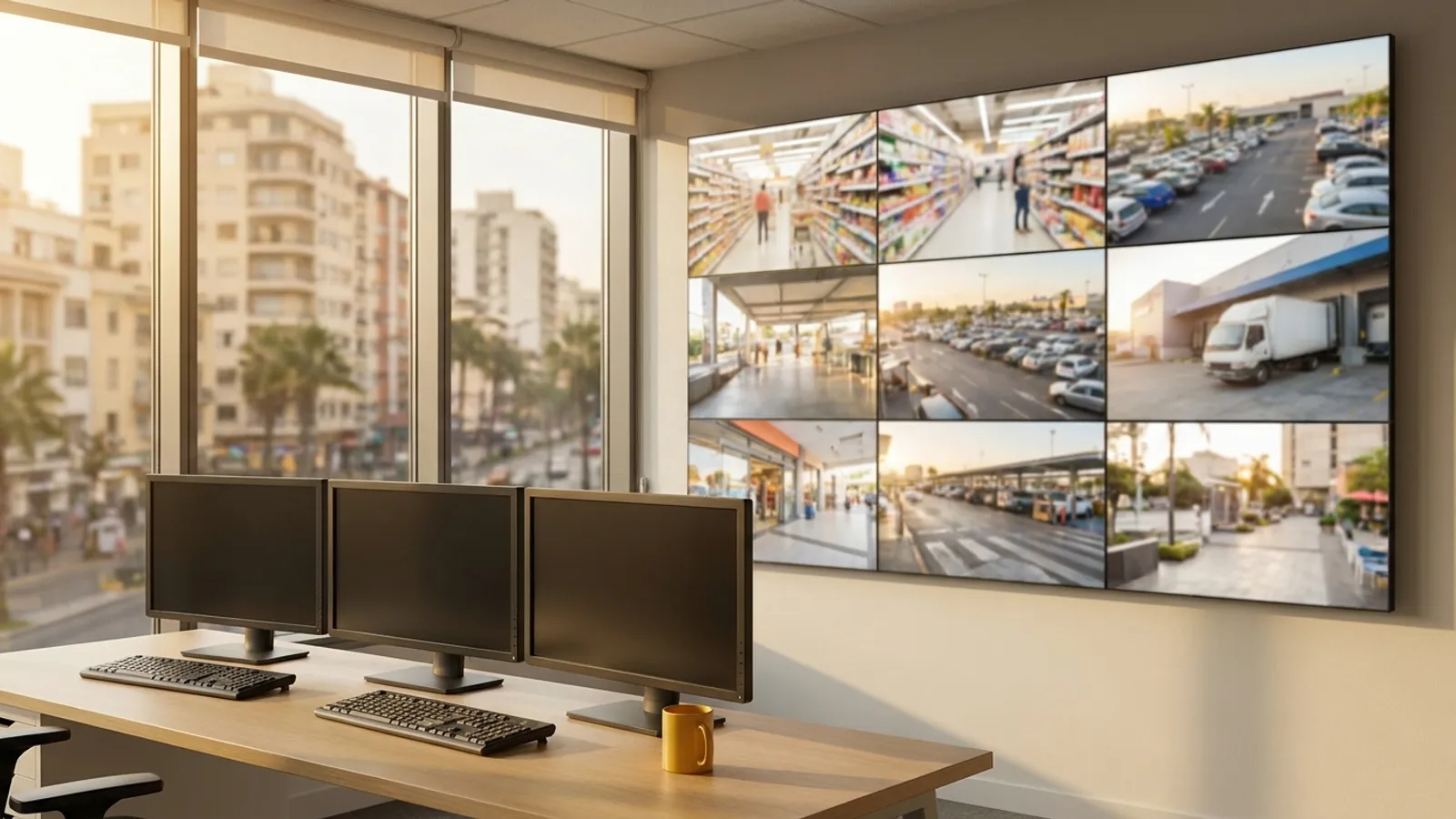
AI video analytics is software that automatically analyzes what cameras capture, both live and recorded. It recognizes people, vehicles, objects and situations, and alerts an operator when something relevant happens. Instead of relying on someone watching the right screen at the right moment, the AI reviews every camera 24/7 and turns thousands of hours of video into alerts, searches and evidence. For a chain with hundreds or thousands of locations, it is the difference between recording "just in case" and knowing what is happening at every store.
How does AI video analytics work?
The process is the same regardless of network size:
- Capture. Cameras at each store, branch or distribution center send their feed (for example, IP cameras via ONVIF or RTSP, or through a VMS).
- Analysis. Computer-vision models process each frame on GPU servers and identify what appears: people, vehicles, license plates, faces and changes in the scene.
- Rules. The team defines what matters. In systems such as OmniSight, these rules are written in natural language, like an instruction to a colleague.
- Alert and human review. When something matches a rule, the system alerts the operator in the corporate monitoring center, who reviews it and decides what to do.
- Search and evidence. Archived video becomes searchable: instead of scrubbing through hours of footage, you search for what you need.
What can it detect across a retail or branch network?
It depends on the system. With Axentra OmniSight, for example, the capabilities are concrete:
- People and vehicles on every camera, tracked from one camera to the next along with the route they took. This helps reconstruct an incident across the parking lot, sales floor and loading dock.
- License plates, fleet numbers and vehicle lettering, relevant for logistics yards, distribution centers and delivery fleets.
- Face recognition against watch lists, where a human operator reviews every match.
- Blocked, turned or out-of-service cameras, detected automatically across the whole chain. You don't have to wait until someone requests footage to find out a camera was down.
- Natural-language rules, such as "alert me if you see an accident."
- Natural-language search across archived video: describe what you are looking for and the system finds the clips.
How is it different from traditional video surveillance?
Traditional surveillance records and depends on people: operators watching a wall of screens and analysts reviewing footage after an incident. It works for a single store, but at chain scale it breaks down by simple arithmetic. No team can watch every camera across hundreds or thousands of stores at once, so no one sees most of the video until it is too late.
AI analytics does not eliminate the operator; it changes the job. Instead of watching screens, operators handle alerts, verify matches and make decisions. A person stays in charge, and the machine does the review no person can do at that scale.
Why does it matter for chains with hundreds or thousands of locations?
Latin American retail operates at massive scale. As context, at the end of 2025 FEMSA reported more than 25,500 OXXO stores worldwide. Networks like this face three problems that video analytics addresses directly:
- Coverage: the corporate monitoring center can only see a fraction of cameras at any given moment.
- Mixed brands: after years of expansion, remodels and different suppliers, cameras and recorders from several brands coexist and cannot be viewed from a single console.
- Cameras going dark unnoticed: a blocked or disconnected camera at a remote store can go weeks without anyone noticing.
For loss prevention, operations and IT, the value is in no longer reacting with recordings and instead acting on alerts, and in finding evidence in seconds instead of hours.
What options does a chain have today?
There are three real alternatives: keep manual monitoring, contract a cloud analytics service, or install AI analytics on your own infrastructure.
| Criterion | Axentra OmniSight | Manual monitoring | Cloud analytics |
|---|---|---|---|
| Coverage | ✓ Every camera, 24/7 | ✗ A fraction, by shift | Varies by plan and vendor |
| Natural-language rules | ✓ | ✗ | Varies by vendor |
| Archived video search | ✓ Natural language, ~40 s | ✗ Manual review | Varies by vendor |
| Cross-camera tracking and route | ✓ People and vehicles | ✗ Manual | Varies by vendor |
| Faces (human-reviewed) and plates, fleet numbers, lettering | ✓ | ✗ | Varies by vendor |
| Blocked, turned or offline cameras | ✓ Automatic detection | ✗ Found out late | Varies by vendor |
| Multi-brand cameras and existing VMS | ✓ ONVIF/RTSP, Milestone, Genetec | ✓ What you already have | Varies; check compatibility |
| Where video lives | ✓ On your servers | ✓ On site | ✗ Processed on third-party servers |
| Depends on cloud services | ✓ No | ✓ No | ✗ Yes |
Bottom line: a cloud service may offer similar features, but OmniSight delivers them on your existing cameras without video leaving the company.
Why Axentra OmniSight for a chain in Mexico and Latin America?
- Analyzes every camera, 24/7. Not a sample, and not just "priority" stores: it processes every camera and sends alerts to the operator.
- Natural-language rules and search. Security and operations teams describe what they need in their own words, and video searches take about 40 seconds.
- Cross-camera tracking. Follows people and vehicles from one camera to another and generates their route, so you can reconstruct full incidents.
- Human-reviewed face recognition and vehicle reading. It runs face recognition against watch lists, and a person reviews every match. It also reads license plates, fleet numbers and vehicle lettering.
- Camera network health. Detects blocked, turned or out-of-service cameras across the whole chain.
- Works with what you already have. It is a unified VMS for cameras from different brands. It works with IP cameras via ONVIF and RTSP, with brands such as Hikvision, Dahua, Axis, Hanwha, Uniview, Bosch, Avigilon, Verkada and Cisco, and with VMS such as Milestone and Genetec. You don't have to replace compatible cameras.
- On-premise. It is installed on GPU servers in the company's own data center. Video never leaves the organization, and the system does not depend on cloud services. Alerts and searches are logged.
To date, OmniSight has detected more than 1 million vehicles and sent more than 1,000 alerts to operators. Axentra is also a single provider for software, security hardware (PTZ, dome and bullet cameras, servers, video walls and consoles) and turnkey projects: engineering, installation, connectivity, maintenance and support.
What should you consider before deploying it?
- Legal framework and privacy. Every company must comply with the applicable legal framework on personal data and video surveillance in each country where it operates, especially if it uses face recognition.
- People in the loop. Define who reviews alerts and who decides. In OmniSight, every face match goes through an operator.
- Infrastructure. On-premise analysis requires GPU servers in your data center and enough connectivity between your locations and that center.
- Measurable use cases. Start with what costs you most: offline cameras, recurring incidents or the time it takes to find evidence.
How can you start without risk?
OmniSight is sold as floating licenses per processed camera, per year. It offers a free 10-day pilot with up to 10 of your own cameras. It is the most direct way to see AI video analytics working in your stores, on your own video, without it leaving your company.
Want to test it across your chain? Let's talk about your pilot.