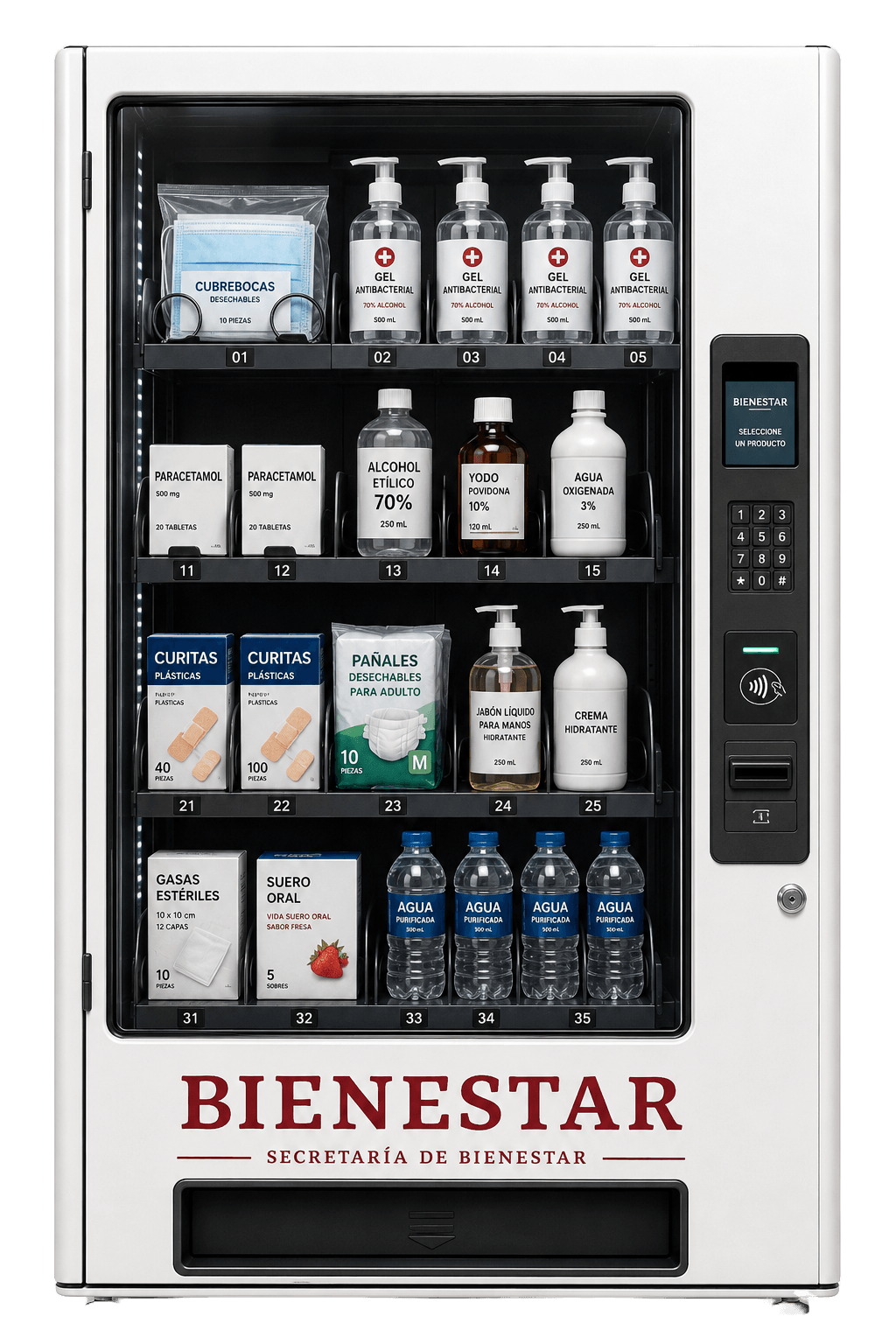
The accountable kiosk for government distribution programs. Verifies the beneficiary, dispenses the item, records every transaction.
Every kiosk is an agency footprint that runs 24/7, wears the agency's brand, and serves citizens close to where they live. Deploy one or deploy a hundred — the program becomes a visible institution in every neighborhood it touches.
A service point that doesn't keep office hours. No window opening at 9am, no line forming at 5am to make sure you get one.
The agency's identity stands in public, every day. Beneficiaries know exactly whose program they're collecting from — no intermediaries between the institution and the citizen.
Goes where people already go — clinics, schools, transit nodes, town centers — not where the agency happens to have its office.
"We served N citizens at M locations" stops being an estimate. Every transaction is logged, every site is countable, every program report is auditable from the underlying records.
The line forms at 5am. Someone hands out kits from a clipboard. The same beneficiary collects twice from a different volunteer two blocks down. Three boxes go missing. By the time the program manager finds out, it's been six weeks and the receipts don't match the population served.
Diversion isn't a moral failure. It's what happens when accountability ends at the program office and the last mile has nothing tracking who got what. Kusto is what tracking who got what looks like when it works without slowing the line down.
From card-tap to item-in-hand, the same path runs end to end with no parallel paper process underneath.
Beneficiary holds their program card to the reader. NFC, magstripe, QR — the kiosk supports all three depending on what the agency already issues.
Card ID hits the agency registry. The kiosk doesn't store beneficiary records — it queries the system of record (DIF, IMSS, SEP, etc.) and gets back a yes/no plus the entitlement.
Entitlement returns: this beneficiary, this program, this period, this allotment. If they already collected, the kiosk says so. If they're not enrolled, the kiosk says that. No second chances on a paper roster.
Slot opens, item is taken, sensor confirms removal, audit log records the full transaction (cardholder, slot, item ID, timestamp). The agency dashboard updates in real time.
Every capability built around one principle: every item dispensed is traceable to a verified beneficiary, with no parallel paper system that can be tampered with afterwards.
NFC, magstripe, or QR — the kiosk reads whatever identity credential the agency already issues. Card ID hits the system of record, agency returns entitlement, no local PII stored on the kiosk.
The kiosk doesn't decide what someone is entitled to. The agency does. Every transaction queries the registry in real time and respects the agency's eligibility logic, including frequency caps and program windows.
Slot opens. Item is taken. A sensor confirms the slot is empty. The transaction only closes once the kiosk knows the beneficiary actually got the item, not just that the door opened.
Every dispense is logged with cardholder, slot, item ID, and timestamp. Records are hashed in a chain so any retroactive edit breaks the next hash and gets caught in the next audit.
The same card cannot collect the same allotment twice. Cross-kiosk and cross-program enforcement runs against the registry, so duplicate attempts are blocked everywhere — not just where the first one happened.
Per-kiosk and per-program inventory streams into Pulse in real time. Restock alerts fire based on actual consumption velocity, not a calendar. Program managers see runway in hours, not estimated weeks.
The kiosk knows how fast it's dispensing. The route system knows where the trucks are. Restock tasks generate automatically against the actual depletion curve, not a fixed schedule that runs whether kiosks are empty or full.
A single kiosk can dispense for multiple agencies and programs at once, each with its own card type, eligibility rules, and slot allocation. One location, one machine, several programs the citizen can collect against on the same trip.
Connectivity drops happen, especially in field deployments. The kiosk keeps running on cached entitlements, queues every transaction locally, and syncs the full ledger the moment connectivity returns. No paper backup needed.
Every kiosk wears the colors and identity of the agency it serves. The citizen sees DIF, SEP, IMSS, or SALUD — not Kusto, not Axentra. Procurement gets accountability without forcing a new brand into the public eye.
For the people who write procurement specs.
Kusto is the physical endpoint. The accountability, analytics, and security around it live in software the agency may already be running.
The kiosk can verify by INE (Mexican voter ID) magstripe or by QR code from the agency's beneficiary app. Some deployments add fingerprint as a fallback, configurable per program. The agency decides what counts as identity proof; the kiosk enforces whatever they decide.
The kiosk does not store beneficiary records locally. It queries the agency registry at transaction time and keeps only the transaction record itself (card ID hash, slot, item, timestamp). Personal information stays in the agency system that already holds it.
Door tamper sensors fire immediately to the operations console. Optional Omnisight camera coverage gives video of any incident. Slot-level locks prevent extraction of more than the authorized item. Cellular cut-off detection escalates if connectivity is severed deliberately.
Yes for the lower-slot configurations (6 and 12 slots), with the right battery package. Mostly relevant for rural pharmaceutical distribution in IMSS-BIENESTAR territories. The compute footprint is small; the constraint is dispensing motor draw.
Either Axentra-managed (we contract regional logistics, restock tasks generated from consumption curves) or agency-managed (Pulse generates the restock list, agency dispatches their own crews). Most pilots start agency-managed; most scale-outs convert to Axentra-managed once volume is real.
Hash-chained ledger entries make retroactive tampering detectable. Federal auditors get read-only access to the full ledger and can verify the merkle root against the on-kiosk hardware. Independent re-verification is supported; we don't gatekeep the audit data.
If you run a distribution program of any size — beneficiaries you have to identify, items you have to hand out, an audit you have to survive — we can scope a pilot. Five kiosks. One program. Four to six weeks to live.