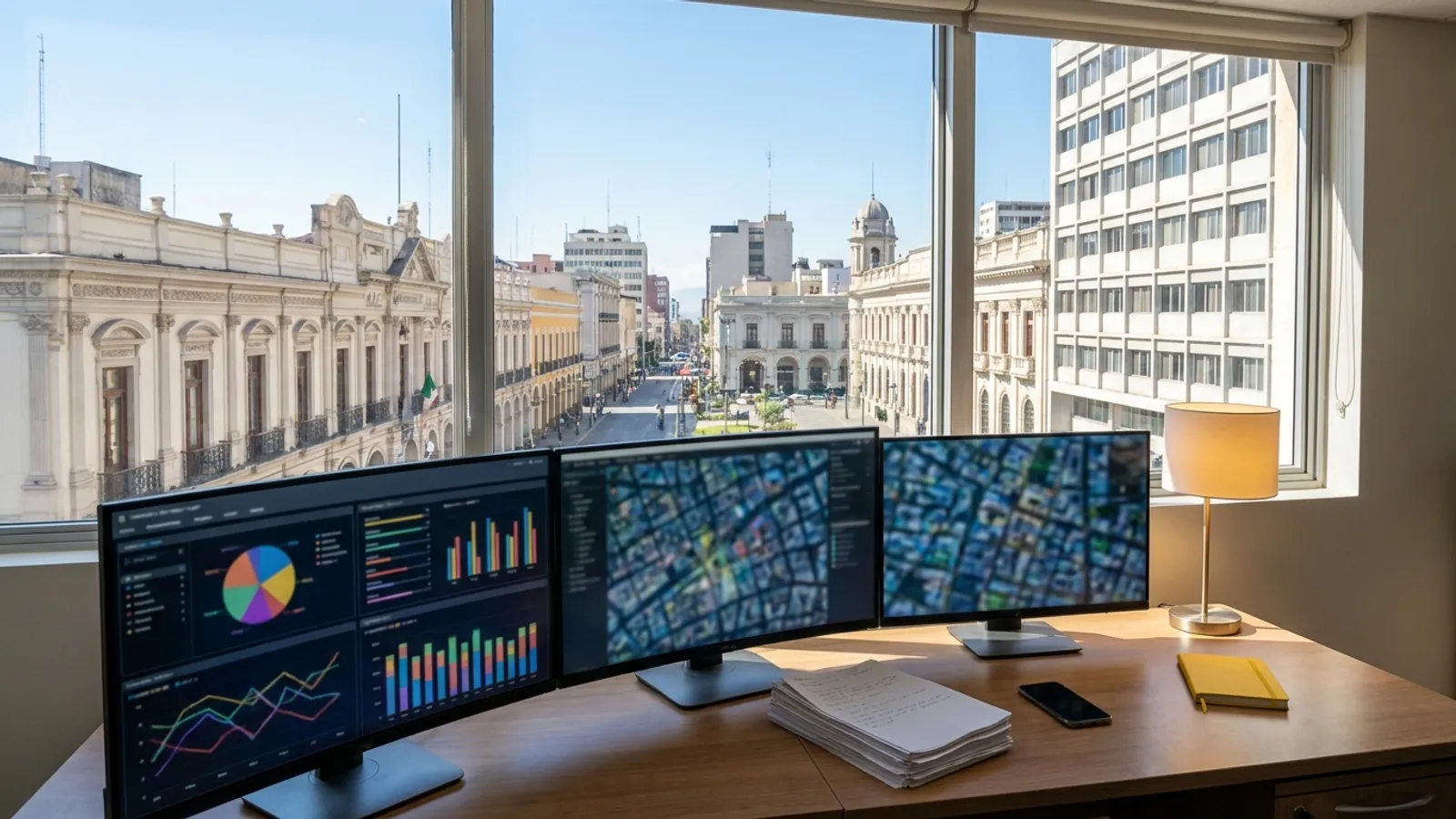
To choose crime analysis software, first check that it works with the data your police force already has (databases, Excel, scanned or handwritten reports, audio and WhatsApp messages) without forcing you to migrate systems. Then verify that it cross-references everything by person, license plate, address or date and answers plain-language questions, citing the source of every data point. Require on-premise installation on the institution's servers, a human making every decision, and a free pilot on your real sources before you sign. A flashy "predictive" heat map does not replace any of these points.
What options does an analysis unit have today?
An analysis unit in a security ministry, a police force or a mayor's office needs to turn complaints, police reports, monitoring-center reports and emergency-line records into answers: where crime concentrates, who keeps reappearing, which vehicle shows up in several incidents. You will see four approaches:
- Spreadsheets and manual reports, sometimes with a business-intelligence tool on top. It is the default: cheap to start, slow to maintain.
- Crime-prediction software. A well-known Spanish-language example is EuroCop Pred-Crime. According to the Elcano Royal Institute, it was Spain's first predictive program, developed by EuroCop with Universitat Jaume I, and it generates heat maps of the areas where a crime is most likely. According to Civio, the company itself says it remained a prototype and was never commercialized.
- Link analysis. i2 Analyst's Notebook is an established Windows tool that reveals relationships between entities and is commonly used by law enforcement; IBM sold the i2 line to Harris Computer in January 2022.
- Large-scale data integration platforms, such as Palantir Gotham, which has been used by the Los Angeles Police Department.
Does crime prediction actually work?
Ask for evidence, not brochures. The Markup analyzed Geolitica (formerly PredPol) predictions for the police in Plainfield, New Jersey, and found they rarely lined up with reported crimes (the success rate was less than half a percent); according to SoundThinking, which absorbed parts of the company, Geolitica would cease operations at the end of 2023. In Spain, Civio reported in 2025 that most police forces deny using predictive software and say what they use is statistical analysis programs; according to Eurocop, its platform includes statistical analysis through a Power BI-based tool, without predictive algorithms.
The lesson is not to discard geographic analysis, but to require that any prediction claim be proven on your institution's own data.
What criteria belong on the evaluation checklist?
Use them in the technical specifications, the demo and the pilot:
- Does it connect to what we already have without migration? Databases, APIs, Excel, CSV, shared folders and in-house systems through custom integrations. If the project starts with "first, move everything into our platform," risk and timelines multiply.
- Does it read information that is not in tables? Much of an investigation lives in handwritten records, scanned complaints, PDF, Word, audio, call recordings and WhatsApp chats.
- Does it cross-reference every source by person, plate, address or date? That is where patterns no single database reveals appear.
- Does it answer in plain Spanish and show where each data point comes from? An answer without a source cannot be verified.
- Does it produce what commanders ask for? Executive reports, dashboards and presentations.
- Where does the data live? The prudent choice is installation in the institution's data center, with no information leaving it. Each institution must also comply with the data-protection legal framework that applies in its country.
- Who decides? The system should assist the analyst, not replace them; no operational decision should come out of a "black box."
- Will the vendor run a pilot on our real sources? Not on demo data the vendor prepared.
How does Axentra OmniData compare with the default option?
Axentra OmniData is an AI data analyst for governments. Here is how it compares with spreadsheets and manual reports:
| Criterion | Axentra OmniData | Spreadsheets and manual reports |
|---|---|---|
| Connects to existing systems | ✓ Databases, APIs, Excel, CSV, folders; no migration | ✗ Manual copy and paste |
| Custom integrations | ✓ Virtually any system via API | ✗ Not applicable |
| Handwriting, scans, PDF, Word | ✓ Turned into structured data | ✗ Manual transcription |
| Audio, calls and WhatsApp | ✓ Turned into structured data | ✗ Manual transcription |
| Cross-reference by person, plate, address or date | ✓ Across all sources | Partial: formulas, one table at a time |
| Plain-language questions (Spanish) | ✓ With data, charts and sources | Usually formulas or an analyst |
| Reports, dashboards, presentations | ✓ In seconds | ✗ Built by hand |
| Where data lives | ✓ On-premise, never leaves the institution | ✓ Local, but scattered copies |
| Cost to start | Free pilot on your real sources | ✓ Already available |
Bottom line: spreadsheets are already on hand; OmniData wins on the manual work of connecting, transcribing and cross-referencing sources, without migrating systems and without data leaving the institution.
What about prediction, link analysis or BI?
- Versus predictive software: OmniData does not sell a prediction. It answers questions with data, charts and the source of each answer, and a person makes the decision.
- Versus i2 Analyst's Notebook: if your unit already works with link charts, i2 is a recognized tool in that space. What to evaluate is whether each alternative reads handwritten records and WhatsApp, accepts plain-Spanish questions with sources, and connects to your systems without migrating them. OmniData does, and it is installed on your own servers.
- Versus a BI tool: for dashboards over clean, structured data, a BI tool is comparable. The difference comes before the dashboard: OmniData reads the documents, audio and messages and cross-references them with every other source.
Where should investigation data live?
On the institution's own infrastructure. OmniData is installed on-premise, in the institution's data center, and the information does not leave it. That is a practical requirement when working with complaints, criminal records and victim data. People make the decisions: OmniData delivers the answer with its source, and the analyst validates it.
OmniData is not limited to police work: it is designed for state and municipal governments in public security and command centers, finance and treasury, health, mobility and the governor's or mayor's office. And Axentra is a single provider for video (OmniSight), emergency lines (OmniCall), data and citizen safety (OmniGuard), with hardware and turnkey delivery if the project needs it.
How do you run a pilot that actually proves something?
- Pick three to five questions your unit is slow to answer today, for example: "which plates appear in robbery complaints and in monitoring-center reports during the last quarter?"
- Include hard sources: handwritten records, scanned PDFs, audio and WhatsApp exports.
- Check every answer against its original source.
- Have analysts, not only directors, use the system.
- Confirm everything runs on your servers.
OmniData offers a free pilot with your institution's real sources, so the decision is made on your data, not on a demo.
Want to test it on your own sources? Talk to the Axentra team.